Reducing annual operating expense by millions while maintaining continuity for tens of thousands of workspace users

Industrious partnered with isofy to migrate nearly 130 active flexible workspace locations from its incumbent provider to the isofy platform, creating a simpler, more cost-effective, and more scalable model for managing internet and network services across its North American portfolio.
The program involved nearly 130 site transitions, more than 250 new internet circuits, and tens of thousands of members, guests, and staff users. Each location was transitioned over a weekend, with isofy onsite as members and staff returned Monday morning.
For Industrious, this was not simply a technology migration. It was a portfolio-wide operating initiative: reduce cost, improve visibility, simplify management, enhance support, and protect the member experience along the way.
 250+ new internet circuits delivered
270+ network racks reconfigured and repatched
58 cities across 23 states and provinces
375+ technician hotel nights
Tens of thousands of users supported through the transition
30 to 50% network operating expense savings per site
Industrious is one of the leading flexible workspace operators in North America, known for delivering premium workspace experiences to companies, teams, and professionals across the globe.
As the company continued to scale, network operations became an increasingly important part of both the member experience and the broader operating model. Connectivity needed to be reliable. Site teams needed better support. Leadership needed clearer visibility across locations. And the organization needed a partner capable of executing a large transition program without disrupting active site operations.
To support these goals, Industrious selected isofy to modernize network operations across its North American portfolio.
For a flexible workspace operator, the network is not a back-office IT function. It shapes the member experience, enterprise-client confidence, how efficiently site teams run, and the operating cost of every location. At portfolio scale, it also shapes how predictably new sites come online and what they cost to operate once open.
Industrious needed to transition nearly 130 active locations away from its incumbent provider while maintaining continuity across the portfolio. Each site served members throughout the week, which meant transition work had to be completed outside normal operating hours and supported carefully when teams returned to the space.
The program also depended on new internet infrastructure. Most sites required two new internet circuits, creating more than 250 carrier timelines, installation requirements, access needs, circuit handoffs, and testing milestones. Each transition depended on the right infrastructure being live, tested, and ready before the cutover window opened.
The challenge was clear: reduce operating expense, simplify network management, improve support, and execute a transition program across all North American locations without compromising the member experience.

isofy paired two capabilities that rarely come from a single provider: a software-enabled enterprise network platform, and a field organization able to deploy it across a live North American portfolio location by location, without taking locations offline during business hours.
One platform across the portfolio
The isofy platform gave Industrious a single pane of glass for network operations across every location: users, devices, networks, reporting, and support in one place. In place of fragmented tools and site-by-site processes, leadership gained portfolio-wide visibility, operational teams gained consistent workflows, and site staff gained a simpler product with a clear path to support. The same platform that runs one location runs the entire portfolio.
Field execution at portfolio scale
A platform alone does not move a live portfolio. isofy self-performed the work most providers subcontract or hand back to the customer: project management, circuit coordination, hardware staging, onsite cutovers, testing, documentation, and post-transition support. Each location followed a planned Friday-to-Monday onsite process, with isofy technicians on the ground as the site reopened. That pairing of platform and self-performed delivery allowed a program of this scale to run as a repeatable rhythm instead of a series of one-off projects.
Establish a reliable, relational technology partnership
Execute a large-scale transition program across all North American workspace locations
Reduce operating expense related to internet and network services
Improve the support experience for site and operational staff
Deliver a simple, easy-to-use dashboard and product experience
Stay agile as site conditions, deployment needs, and business priorities evolved
Each location followed a repeatable Friday-to-Monday transition model designed to protect weekday operations.
Before each cutover, isofy and Industrious confirmed site readiness, circuit status, building access, hardware requirements, and local operating considerations. With more than 250 internet circuits involved, circuit readiness was managed as a critical path dependency: each site needed the right infrastructure live, tested, and ready before transition work could begin.
Cutover work started after hours on Friday and continued through the weekend, allowing the most disruptive activity to happen outside normal business operations. isofy completed configuration, validation, troubleshooting, documentation updates, and site-specific testing before members and staff returned.
On Monday, isofy remained onsite to support the local team, address any post-transition questions, and help ensure a smooth return to normal operations.
This model gave Industrious a consistent, repeatable transition playbook across its portfolio while still allowing each location to be handled with the care required for an active workspace environment.
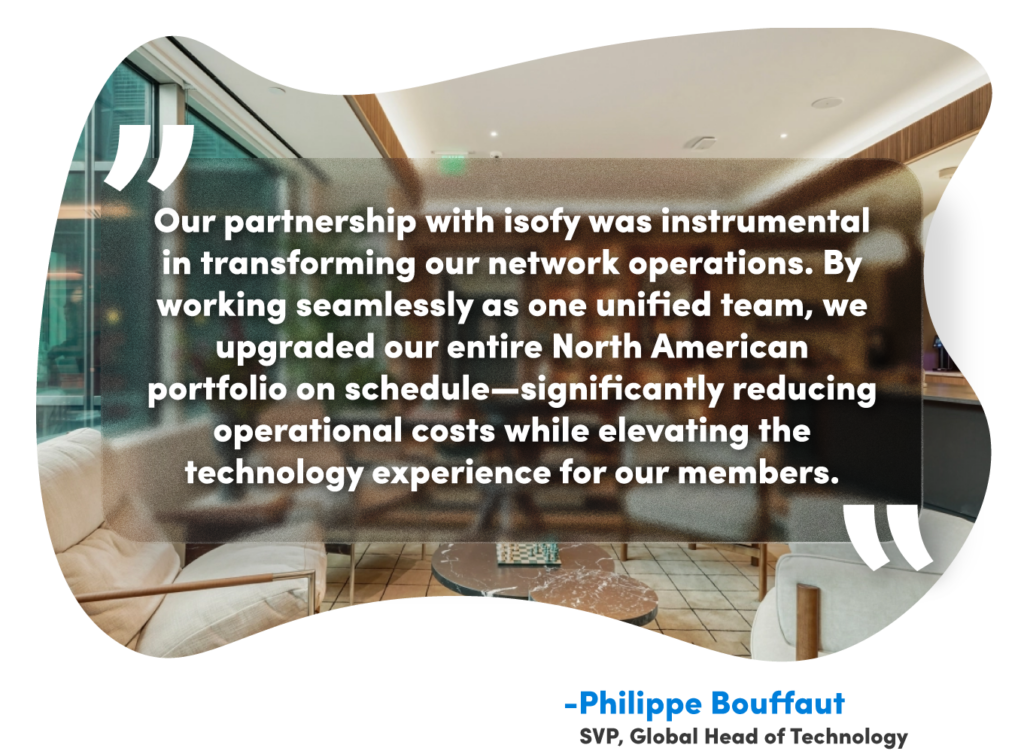
The program delivered measurable results across spend, operations, support, and member experience. For Industrious, these were not isolated IT wins. They changed how the portfolio operates and what it costs to run.
Cost Efficiency
The transition reduced annual operating expense by millions of dollars, and it did so by removing structural cost rather than cutting service: consolidating internet and network services onto one operating model, moving to transparent carrier pricing without markups, and standardizing the network across locations. Because connectivity is a recurring operating cost, that reduction flows directly to net operating income, year after year, across every site in the portfolio.
Key outcomes included: Millions in recurring annual operating expense savings, supporting portfolio NOI
Transparent carrier pricing replaced incumbent circuit markups
Internet and network services consolidated onto a single operating model
A cost structure that scales predictably as the portfolio adds locations
Operational Control
The migration gave Industrious a simpler and more consistent way to manage network operations across locations.
Key outcomes included: Consolidated management across locations
Improved reporting and network insights
Greater visibility into users, devices, and site-level activity
Brand uniformity; more consistent network operating standards across the portfolio
A simpler dashboard and product experience for internal teams

Support Experience
The program improved the support experience for site teams, operational staff, and the broader Industrious technology organization.
Key outcomes included: Onsite support during each transition weekend
Monday go-live support as members and staff returned
Faster identification and resolution of site-level issues
Clearer escalation paths
Improved support experience for site and operational staff
Member Experience Continuity
For members, the goal was simple: Monday morning needed to work. Industrious is known for its hospitality-centric approach to the member experience and this transition was no different.
The transition model was designed to complete the most disruptive work outside normal business hours and provide onsite support as each location returned to operation. That approach helped protect the member experience while the underlying network platform changed.
Key outcomes included: Reduced business-hour disruption during transitions
More consistent connectivity across locations
Secure, branded Wi-Fi experiences for members and guests
Improved support for site staff serving members
A stronger technology foundation for enterprise workspace users
The program succeeded because Industrious and isofy approached the transition as an integrated operating initiative, not a vendor handoff.
Integrated partnership
Industrious and isofy worked as one project team across scheduling, circuit readiness, site access, field execution, and go-live support. That trust mattered because each transition involved active workspace locations, tight timelines, and multiple stakeholders.
Critical path discipline
With more than 250 internet circuits involved, readiness had to be managed carefully. Each transition depended on the right infrastructure being live, tested, and ready before cutover work began.
Repeatable onsite execution
The Friday-to-Monday onsite model gave the program consistency while still allowing each location to be handled with care. The approach proved scalable, with some weekends supporting up to six concurrent site transitions.
Industrious transformed network operations across its North American portfolio, reducing annual operating expense while maintaining continuity for tens of thousands of users.
For Industrious, the program delivered more than a provider change. It created a stronger operating model: lower cost, better visibility, improved support, simpler tools, and a more consistent brand experience across locations.
For isofy, the program proved out a model built for multi-site operators: one platform and one team spanning software, field execution, and support across an entire portfolio.
For operators carrying connectivity costs they cannot see clearly, a member experience that varies site to site, and no single view of their network, the takeaway is direct. Network operations now sit inside the operating model and the performance of the asset itself. Run well, they lower cost, de-risk expansion, and protect the experience the portfolio is built to deliver.